


Bitcoin Holds $64K as ETF Outflows and Weak Futures Signal Demand Vacuum
Four sessions of US spot Bitcoin ETF outflows totalling $526.5M, softer futures demand, and stagnant on-chain inflows put $64,000 support to the test.

Bitcoin entered July 29 trading near $64,200 with three demand channels losing momentum simultaneously – four consecutive US spot Bitcoin ETF sessions produced a combined $526.5 million in net outflows, Glassnode reported weaker perpetual futures buying pressure, and broader on-chain capital inflows remained stagnant, leaving $64,000 as an immediate market test rather than a guaranteed floor.
ETF Outflows Break a $999 Million Inflow Streak
The four-session drawdown was not uniform. According to tracking data from Farside Investors, outflows registered at $225.1 million on July 23, $240.1 million on July 24, $11.6 million on July 27, and $49.7 million on July 28. The July 23–24 sessions carried the bulk of the damage, with BlackRock’s IBIT accounting for roughly 90% of the July 23 reversal that erased 22.5% of a preceding $999.3 million inflow streak and pushed Bitcoin below $65,000 by session close.
CryptoSlate noted that finalized ETF flows can reflect positioning established at different points during a trading session, meaning the outflow figures show weakness in a major regulated demand channel without establishing the precise cause of Bitcoin’s price move. For broader context on how ETF flows and exchange withdrawals interact around this price range, earlier analysis of Bitcoin ETF inflows and exchange outflows near the $64K–$66K band showed how divergences between those two channels can obscure the net demand picture.
Perpetual Futures and On-Chain Signals Turn Cautious
Glassnode’s Week 31 market pulse described Bitcoin retreating from roughly $66,700 toward $64,000 before a partial recovery to approximately $65,100. Within that range, buy-side aggression in perpetual futures had declined and long-side funding payments had cooled sharply, even as aggregate open interest ticked slightly higher – a combination that points to more cautious leverage rather than a wholesale withdrawal of derivatives exposure.
On-chain measures offered little evidence of fresh capital stepping in to fill the gap. Glassnode found active addresses steady but economic settlement and transaction pressure restrained, with broader capital inflows described as stagnant. Regulated investment products had shifted into net outflows and weekly trading volume had declined – reinforcing the picture of a market where existing participants are holding positions but new capital is not entering in size.
The derivatives signal is not uniformly bearish. A separate CryptoSlate options analysis found approximately 52 open put contracts for every 100 calls, down from 76 in late June – a meaningful reduction in hedging demand. The premium for one-week downside protection had also eased, though puts continued to trade above comparable calls. Options traders were carrying less immediate crash protection even as perpetual futures demand softened, creating the kind of asymmetric positioning that can amplify moves in either direction.
Long-Term Holders Remain the Primary Buffer
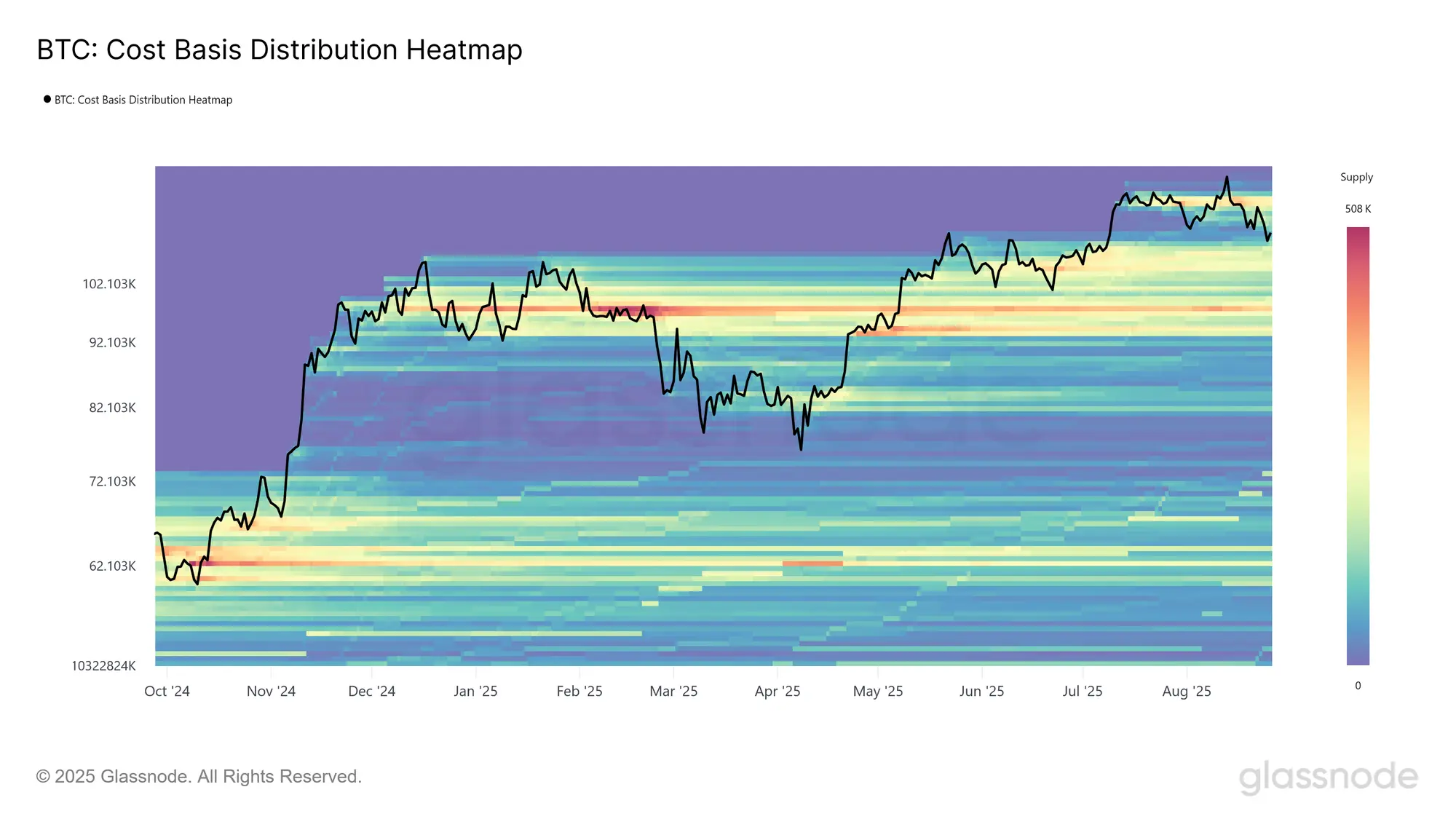
With ETF flows, derivatives, and on-chain inflows all softening simultaneously, the stabilizing force identified by Glassnode is long-term holder conviction. The firm noted that long-term holders continued to show conviction while aggregate unrealized losses declined modestly and realized losses eased – dynamics that help explain why the convergence of weaker demand channels has not, by itself, broken the $64,000 level. Analysis of institutional long-term holder behavior at current price levels provides additional context on how this cohort has historically functioned as a structural stabilizer during demand drawdowns.
The holder-buffer thesis is not unconditional. Glassnode framed the conditions under which it would weaken: a sustained break below the local range accompanied by renewed long-term holder distribution, rising realized losses, or accelerating selling pressure would remove the stabilizing forces currently holding the line. A brief dip below $64,000 without those deteriorating signals would represent a deeper price test but would not by itself establish that the support structure had broken. For insight into where whale-level distribution and accumulation patterns currently sit, on-chain analysis of whale distribution dynamics around similar price levels is directly relevant to assessing whether large holders are adding or reducing exposure.
Bearish Case: Support Gives Without a Holder Shift
The downside scenario does not require long-term holders to capitulate immediately. If perpetual futures demand continues to soften while ETF redemptions persist – even at the reduced pace seen on July 27 and 28 – the absence of new capital formation creates a structural vacuum that price will eventually need to fill. A sustained close below $64,000 paired with any uptick in long-term holder realized losses would shift the mechanical setup materially, removing the one demand pillar that Glassnode currently identifies as intact.
Bullish Recovery: Three Channels Need to Reverse Together
The bull case requires more than a single channel turning. A genuine recovery above $65,000–$66,700 – the range from which Bitcoin retreated into the current test – would need ETF flows to return to net inflows, perpetual futures buy-side aggression to rebuild, and on-chain settlement to show evidence of fresh capital entry rather than existing-holder recirculation. The put-to-call ratio declining to 52 from 76 suggests some options traders are positioning for upside, but that shift in hedging behavior alone does not generate the demand-side mechanics required to reclaim prior highs.
The path of least resistance remains lower as long as all three demand channels stay in the configuration Glassnode and Farside Investors described on July 29, with $64,000 the immediate structural level the market will be forced to price against any further deterioration in ETF flows or long-term holder behavior.
Follow CoinNews on X and Telegram for live updates on Bitcoin ETF flows, on-chain signals, and key support levels as this test develops.
About Author

About Author